Sunday, September 11, 2016

Called to be whole


My I urge, then, first of all, that petitions, prayers, intercession and thanksgiving be made for all people - for kings and all those in authority, that we may live peaceful and quiet lives in all godliness and holiness. This is good, and pleases God our Saviour, who wants all people to be saved and to come to a knowledge of the truth.

1 Timothy 2:1 - 3

As Catholic schools we should not be ashamed of our mission to encourage and grow to holiness. The call to holiness (and wholeness) is made to all Christians. But what is holiness, and why is it so important? Holiness is derived from God as an expression of his extraordinary and immense goodness. As believers we participate in this holiness through our experience of God’s presence in our lives. We do not automatically share in that holiness: each of us must respond to the call, grow in awareness of God’s presence, express it through gratitude, humility, love and justice for others. This doesn’t make us holy, it means we gain a share, a space, a place in God’s holiness.

Holiness is important because it permits and resources our capacity to live full and rich lives (wholeness – they’re intimately related).

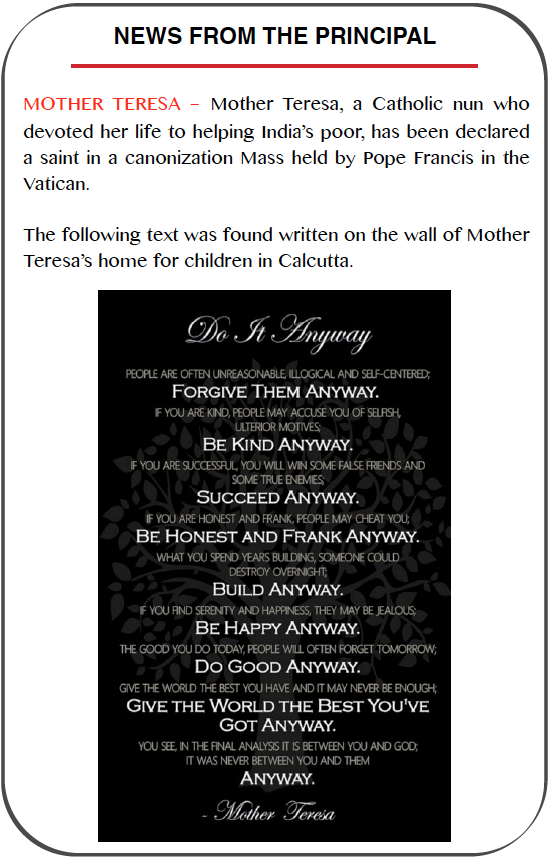
So, what does holiness look like? We have certainly seen it in the lives of St Teresa of Kolkata, St John Paul (II), St John (XXIII) and surely in the life of the Dalai Lama. But they are very religious. I’m reasonably sure, however, that religious people do not have a stranglehold on holiness. For gratitude, humility, love and justice for others are experienced and expressed by so many about us. I have been privileged in my life in having met a raft of ‘holy’ people – bishops, priests, religious brothers and sisters, but most have been people like you. Yet when I see the devotion of wives for their husbands, fathers for their children, grandparents for their grandchildren, friends for one another, I see quite clearly how God’s holiness overflows into their lives and it is quite awe inspiring.

Coming to recognise God’s role in this generous giving is what our job in Catholic education is. In Paul’s letter to Timothy (6:11-16) we are asked to be ‘filled with faith and love, (be) patient and gentle’ – that is, we must seek to be holy.

What this means on a day-to-day basis will be entirely dependent upon your gifts and capacity. In some instances it may mean offering your every living moment to others through a life of contemplative prayer, or being a nurse, a teacher, a emergency services worker, office worker, stay at home mum or dad.

We must ‘fight the good fight with all our might’ so that the daily grind itself does not become our reason for living, the fight is to ensure we can see our wholeness being unfolded in word and action. Wherever we are in our lives that is where our holiness, our place and space with God lies.

Peter Douglas
HEAD OF SCHOOL SERVICES, NORTH


God's joy

America Magazine/August 29-September 6, 2016 Issue [2]


John W. Martens 

“Against you, you alone, have I sinned, and done what is evil in your sight” (Ps 51:4)

I hate sin. Not enough to stop doing it, try as I might, but I truly hate it. The older I get, the more I recognize sin as persistent foolishness, darkness and nothingness that pulls me away from God, whispers false promises in my ears about new pleasures, asks, “Why not?” or assures me, “You deserve it!” With the purported author of Psalm 51, King David, I can say with honesty that “I know my transgressions, and my sin is ever before me.” And I know now, with the psalmist, that “against you, you alone, have I sinned, and done what is evil in your sight” because every sin against another of God’s creatures or God’s creation is an act that draws me away from God’s love and the joy that God has prepared for me.

I might not be the foremost sinner. The author of 1 Timothy, traditionally ascribed to the apostle Paul, claims that title, saying that he “was formerly a blasphemer, a persecutor, and a man of violence” and, indeed, “first” among sinners. But that’s the point, is it not? When we are caught up in sin, or are coming down from the false high of sin, we feel that we are the worst of sinners, knowing better what we ought to do but still doing it. This can lead not just to proper repentance and confession, but sometimes to a sense of worthlessness and self-recrimination. Who are we to deserve God’s love? Why would God want me, of all people?

This is why it is important to stress that God cares for us at every point in our lives. Even if we feel we are not worthy of forgiveness, “Christ Jesus came into the world to save sinners—of whom I am the foremost.” It is “for that very reason,” Paul says, that “I received mercy, so that in me, as the foremost, Jesus Christ might display the utmost patience, making me an example to those who would come to believe in him for eternal life.” If the foremost sinner received mercy, you can, too. In fact, come and get it now.

God wants our repentance, not to demand obeisance but because we were created out of being for being, not out of nothingness for nothingness. God’s desire for us is for our true nature and destiny to be realized. We see this when the Israelites out of Egypt quickly turn from their saviour and the commandments given them to a golden calf. God tells Moses his wrath is burning “hot against them.” Moses, though, implores God and says, “Remember Abraham, Isaac, and Israel, your servants” and the promises of descendants and the land. In response, “the Lord changed his mind about the disaster that he planned to bring on his people.” As much as God hates sin, God loves us even more. This is why mercy, not punishment, is the gift that God offers us over and over.

This is not just an offer sitting on a back shelf somewhere. This offer was brought to us by God’s son, who came to seek us out and offer us the gift prepared for us. The set of so-called lost parables in Luke begins with an account of grumbling on the part of the religious experts of Jesus’ day because he was eating with tax collectors and sinners. It is in response to these complaints that Jesus tells three stories of a lost sheep, a lost coin and a lost son. They are so well known that we have to exercise care that their grit and groundedness in everyday life not get lost: God seeks out sinners in whatever muck he finds us in.

God rejoices over us when we are found. Listen to the endings of the three lost parables: “There will be more joy in heaven over one sinner who repents,” Jesus says, “than over ninety-nine righteous persons who need no repentance”; “There is joy in the presence of the angels of God over one sinner who repents”; “But we had to celebrate and rejoice, because this brother of yours was dead and has come to life; he was lost and has been found.”

As much as sin stalks us, when I look back at my life I see how many mercies and graces there have been, how God has been picking me up every time I fell and dusting me off. God keeps standing us up and telling us to turn away from sin and come home, for now is the time to share in God’s joy.

John W. Martens is a professor of theology at the University of St. Thomas, St. Paul, Minn. 

Readings: Ex 32:7-14; Ps 51:3-19; 1 Tm 1: 12-17; Lk 15:1-32


Literacy Strategy Year 2 schools at MacKillop Centre.


Peter's Whereabouts for the next two weeks:


Upcoming Events:


From St Anthony's - Riverside:

From St Finn Barr's - Invermay:


From St Joseph's - Queenstown:


From Stella Maris - Burnie:


From St Brendan Shaw College - Devonport:


From St Brigid's - Wynyard:


From Our Lady of Mercy - Deloraine:


From St Patrick's College - Prospect:


From Star of the Sea - Georgetown:


From Our Lady of Lourdes - Devonport:

From St Joseph's - Rosebery:

From St Patrick's - Latrobe:


From Sacred Heart - Launceston:


From Sacred Heart - Ulverstone:

From Larmenier - St Leonards:


 From St Thomas More's - Newstead:


From Marist Regional College - Burnie:


From St Peter Chanel - Smithton:


Monday, September 5, 2016

The problem is evil


But Moses pleaded with the Lord his God. ‘Lord,’ he said, ‘why should your wrath blaze out against this people of yours whom you brought out of the land of Egypt with arm outstretched and mighty hand? Remember AbrahamIsaac and Jacob, your servants to whom by your own self you swore and made this promise: I will make your offspring as many as the stars of heaven, and all this land which I promised I will give to your descendants, and it shall be their heritage for ever.’ So the Lord relented and did not bring on his people the disaster he had threatened.

Exodus 32:13 - 14

The Hebrews had a worldview in which the hand of God was ever-present, and many of the troubles visited upon them they saw as a response to their infidelity. That God would strike people down, cause great catastrophes, is beyond the relational God revealed through Jesus. And yet many cannot move beyond a God who allows children to die or permits disasters - natural and human.

There are some extraordinarily compelling stories about the problem of evil and the consequential loss or lack of faith in a loving God. It has been a heck of a year thus far. The natural disasters that have struck Central Italy and Ecuador, and the unnatural acts of terrorism in Jakarta, Iraq, Nigeria, Syria, Afghanistan, Orlando and Turkey, have left humanity wondering. Wondering what it is that these victims have done to deserve the tragedy of loss of home, livelihood, family and life itself. Thinking about why evil appears to prevail in a world when we so firmly believe in a loving, life-giving God, has a name: theodicy. It is the problem of evil.

When 316,000 die in an earthquake and 300,000 left injured (in Haiti's earthquake of 1 December 2010), and uncountable millions are left homeless, it puts paid to our tidy universe. And we have three ways to respond – we can bend our heads seeking an answer; we can do all we can to alleviate the suffering of the victims, or we can do nothing. I am all for seeking an answer to this problem, some of the greatest minds of the past two millennia have attempted to solve it – Augustine, Thomas Aquinas, Gottfried Liebniz. There are no satisfactory conclusions to their quest. That probably leaves us with two choices.

Empathy is the capacity to feel what others are experiencing, it means to suffer with them. The calls on our empathy, and our pockets have been consistent. The media cajoles us into responding, and over time it becomes easier to ignore. Some describe it as disaster fatigue.

Yet, the ways we can respond are many. There is, foremost, prayer. Prayer is a powerful tool. It engages the mind, heart and soul, proceeding to action. We can donate: that includes our time, money, goods, expertise. We can become involved through joining a relief agency, giving monthly, lobbying politicians to do more – about terrorism, about global warming, about education, about development. It is not just about giving money, though giving money is a great beginning. It is about self-giving, self-emptying. Indeed, it is being Christ-like.

The world of 2016 is as intimate as mobile phone, or television. What you see on the news begs of you to respond with similar intimacy and compassion. The tormented lives you see are those of living human beings, they are our neighbours, our earthly companions, fellow journeymen whose hopes and dreams have been destroyed. Give them hope, and give.

The closest I can get to find an answer to the problem of evil is: God gives us the capacity the reject evil and assists us in transforming the world, imperfect as it is, into his kingdom. In that imperfect world the Hebrews saw the absence of disaster as the mercy of God, for in that mercy God had heard their cry for help and in his relenting he would give life.


Peter Douglas
HEAD OF SCHOOL SERVICES, NORTH


How God as Trinity Dissolves Racism
by Richard Rohr


This summer, as has been true for the past few summers, racism has made headline news. Deep divisions have been put in the spotlight, and it can sometimes feel as if that spotlight has served to dig them even deeper.

But we can’t confront racial strife if we don’t acknowledge that it exists. The challenge is that racism does not just have a deep root, but has many deep roots in our lives, communities, and country.

Like much of our nation, I’ve been doing substantial soul-searching to seek understanding about my own actions, beliefs, and behaviors, as well as the systemic patterns that write collective actions, beliefs, and behaviors in quite large letters across our society.

What I’m coming to understand through this reflection is startling, and might surely seem like a non-sequitur. But here it is:

The widespread Christian failure to understand and experience God as Trinity has provided a breeding ground for both implicit and explicit racism.

To understand a sin that is as old as history, it is helpful to go back to one of the oldest questions of human inquiry.

When I studied the history of philosophy in the early 1960s, I was told that the first and foundational philosophical problem that keeps recurring in every age and in different forms is “the problem of the one and the many”: How can there be any primal unity to reality when what we see is so much obvious and seemingly conflicting diversity? Is there any unifying pattern to “the ten thousand things” that overwhelm our horizon?

This remains our issue today, at least for those of us who look for “big-picture narratives” that speak to the confusion that still confronts us. Theology always made the claim that it had the power to offer us the biggest picture of all (the “Reign of God” in Jesus’ language), even though it all too often offered us rather small, self-serving, and tribal images of God. Without knowing it, and contrary to its own unique revelation, I think much of Christian history did the same thing.

Let’s look at one of the very destructive effects of a diminished, anti-transformative image of God on the perennial and ubiquitous issue of racism. Today, most Christian notions of the Divine are much more formed by pagan and Greek conceptions than by the central Christian doctrine of the Trinity. Even the Latin word for God, Deus, is a direct reformulation of the Greek word for the head of the gods, Zeus. I believe racism is often rooted in this distorted view of divinity; rather than reflecting the One who created all things in God’s own “image and likeness” (Genesis 1:26-27), we instead make God into a mascot who, as Anne Lamott brilliantly quips, hates all the same people we do.

When you start with a conception of God as an old white man sitting in the clouds, it is of little surprise that white men, preferably empowered white men, are considered the closest to God and the most worthy of respect and value. It becomes a top-down universe, a pyramid much more than the circular dance (perichoresis). Perichoresis, the Trinity as dance, is indeed the precise and daring image that ignited some of our early church fathers’ finest intuitions, prompting consensus around this utterly new revelation of God. It took them three centuries to make full sense out of Jesus’ often-confusing language about what he named “Father,” how he understood himself, and what he named the “Holy Spirit.” Our common form of dualistic thinking just could not process such three­-fold and one-ness evocations at the same time.

It was frankly, illogical — and even silly.

How could we reconcile what seemed like a huge logical and theological conundrum, especially for thoroughgoing monotheistic Jews? The human ego is so resistant to anything its mind cannot quickly process and control; it prefers separateness and a sense of superiority — precisely what the Trinity rejects and denies.

Yet if we do not discern and celebrate difference on the level of what visible humanness means, what hope is there on issues where “difference” is often much more striking (gender, power, class, education, etc.)? Every one of these issues is searching for its own locus of authority today, and as naïve as it might sound to some, I believe Trinity does provide such an appropriate locus of authority for those who are willing to trust and allow it. God is precisely one by holding together very real difference.

The Godhead itself maintains separate identity between Three, with an absolutely unique kind of unity, which is the very shape of Divine Oneness.

God’s pattern and goal has never been naïve uniformity but radical diversity (1 Corinthians 12:4ff) maintained in absolute unity by “a perfect love” that infinitely self-empties and infinitely outpours—at the same time.

This Divine pattern is, of course, most beautifully revealed in “all the array [pleroma, or fullness] of creation” (Genesis 2:1). God is forever “making room” and “infilling”; this is the Way of the Flow. This is, in our finite understandings, an utterly new logic and is the foundational template for the success of the human project for those ready to embrace at the level of experience what they already confess in the creeds. Indeed, many collaborative and synergistic souls “outside the fold” of Christianity live this better than some who formally believe in the doctrine of the Trinity.

Of course, it is precisely self-emptying that the human ego resists and opposes; without this the whole waterwheel of divine love does not flow at all — at least through us.

We like infilling, but we do not know how to make room for that infilling.

This is always and forever the spiritual problem. This is racism, sexism, classism, ageism, lookism, homophobia, transphobia, imperialism, patriarchy, and all that the tradition courageously refers to as “sin.”

In my reading of the Gospels, this explains why Jesus had to dramatically come and personally exemplify the entire path of self-emptying (the kenosis of Philippians 2:7) and making room for “otherness” (John 16:7 and implied throughout John 14-17). The Jesus path is a constant visible lesson in both allowing and handing on, receiving and giving away what is received. He makes the Divine Waterwheel visible and attractive, so we can trust this always-daring process ourselves and even fall in love with it (1 John 1:1-2). To step into what this mighty river of God’s mercy and restorative justice has always been doing — challenging idols of totalizing false oneness under their guise of uniformity, while allowing the flow of many streams together into genuine oneness.

Christ is the choreography of new creation made visible, and we are still being invited to take this dance.


Peter's Whereabouts for the next two weeks:


Upcoming Events:


From Larmenier - St Leonards:


From Our Lady of Mercy - Deloraine:


From Stella Maris - Burnie:


From Marist Regional College - Burnie:


From Sacred Heart - Launceston:


From St Anthony's - Riverside:


From St Finn Barr's - Invermay:


From Sacred Heart - Ulverstone:

From St Brendan Shaw College - Devonport:


From St Brigid's - Wynyard:

From St Thomas More's - Newstead:


From St Patrick's - Latrobe:

From Star of the Sea - Georgetown:


From St Peter Chanel - Smithton:


From St Joseph's - Rosebery:

 From Our Lady of Lourdes - Devonport:


 From St Patrick's College - Prospect:

From St Joseph's - Queenstown: